
Good morning. It's Friday, June 24.
| • | Supreme Court ruling on guns reverberates in California. |
| • | Regulators order Juul to halt e-cigarette sales in U.S. |
| • | And a family's heart-wrenching spiral into homelessness. |
Statewide

Ammunition boxes were displayed at a gun shop in Placerville.
Adobe
The U.S. Supreme Court on Thursday ruled that Americans have a constitutional right to carry concealed firearms in public. The decision struck down a New York law requiring "proper cause" to carry a gun outside but it also applied to a similar law in California. "Confining the right to 'bear' arms to the home would make little sense," Justice Clarence Thomas wrote for a partisan 6-3 majority. Democratic leaders in California vowed to introduce legislation within days to blunt the impact of the ruling. L.A. Times | A.P.
The Atlantic: "With this morning’s Supreme Court decision, the only real remaining question is not whether Americans can carry firearms, but where."


In early March, Gov. Gavin Newsom vowed "immediate action" to provide relief as gas prices soared. More than three months later, Californians are still waiting. Despite an overflowing budget, Newsom and legislative leaders have been at odds over whether payouts should be tied to vehicle ownership or income — and neither is budging. Some moderate Democrats are so frustrated they are now efectively aligning with Republicans to demand suspension of the state's gas tax. Politico
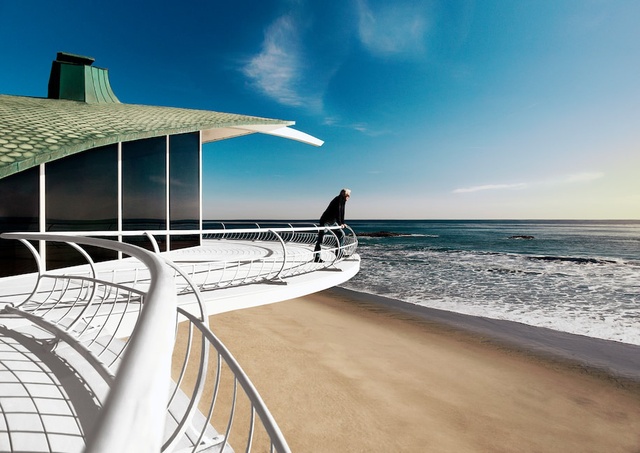
Harry Gesner on the balcony of his Wave House.
Steven Lippman
The California architect Harry Gesner died this month at 97. His obituary reads like an adventure novel. Growing up, he could surf and ski like a pro and flew a plane at age 14. His first love, as a senior at Santa Monica High, was the actress June Lockhart. But the romance was cut short by World War II, and at age 19 he took part in the D-Day landing at Normandy. After the war, he excavated pre-Incan artifacts in Ecuador, ran into Errol Flynn at a bar in Mexico City, and attended a class taught by Frank Lloyd Wright. Largely self-taught, Gesner designed dozens of prized homes around Los Angeles over his career. The most famous of them is the Wave House in Malibu, pictured above, with crested roofs that jut over the ocean like waves. N.Y. Times
Northern California
The Food and Drug Administration on Thursday ordered Juul to stop selling e-cigarettes in the U.S., a devastating blow to the San Francisco company. Juul's initial dominance of the vaping market invited intense scrutiny from groups that worried the sleek devices and prefilled pods in flavors like mango and cucumber harmed young people. Explaining the decision, the FDA said Juul failed to prove that its devices were safe. Washington Post | A.P.
Tule Lake is vanishing. Once vast and thriving, the intermittent lake near the Oregon border has been transformed by drought into a moonlike landscape with cracks in the exposed lakebed wide enough to slip your hand into. Birdlife has declined, croplands have been left idle, and workers are moving out. "You get to the lake and it’s just empty," said Ryan Finney, who works in agriculture. "And it sucks — all the wildlife that should be there that’s not. It’s pretty sad." Siskiyou Daily News
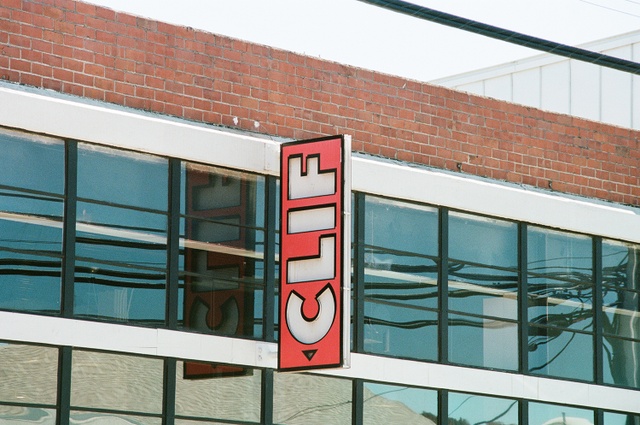
Clif Bar is headquartered in Emeryville.
Smith Collection/Gado/Getty Images
In 1990, a bakery owner in Berkeley named Gary Erickson had the idea to make a better energy bar after choking down five unappetizing bars during a 175-mile bike ride. Clif Bar was born. After 10 years, Quaker Oats offered $120 million for the company. But Erickson walked away, assuming massive debt to stay afloat. It turned out to be a prudent decision. On Monday, Erickson and his wife accepted a $2.9 billion buyout from snack giant Mondelez International. Forbes | Bloomberg
On this week's California Sun Podcast, host Jeff Schechtman talks with Alexa Koenig, executive director of UC Berkeley's Human Rights Center. They discussed how smartphones and digital research methods are transforming the way we expose and prosecute human rights atrocities around the world.
Southern California
Before the pandemic, Natalie and Dustin Raschke comfortably supported their family of six with bartending jobs. They had two cars and money in the bank. After losing their jobs, they decided to live out of an RV until the economy opened back up. But shortly into their stay at an RV park in San Diego, they were unexpectedly asked to leave. With nowhere to go, they racked up so many parking tickets that police impounded the RV. That's when the Raschkes faced a reality that seemed inconceivable: They were homeless. "Every day, I’m like, how is this happening to me?" Natalie said. Voice of San Diego

Containers were piled up at the Port of Los Angeles on January 19.
Qian Weizhong/VCG via Getty Images
One baffling outcome of the bottleneck at the ports of Long Beach and Los Angeles: The ocean shipping industry is recording huge profits. Carriers have been charging exorbitant fees on shipping containers stuck at port, a cost that gets passed to consumers in the form of higher retail prices. "It’s like renting a car at the airport, and when you try to return it, they’re saying, 'No, you have to hang on to it for us, and we’re gonna continue to charge you,'" said Fred Johring, the CEO of a California trucking firm. ProPublica
Over the years, one of Los Angeles' most prominent landlords withheld security deposits from more than 19,000 tenants when they moved out of his apartment complexes. Now Geoffrey Palmer has agreed to pay $12.5 million to settle a class-action lawsuit. A lawyer for former residents said he expected the settlement to cover the full return of security deposits to his clients. L.A. Times
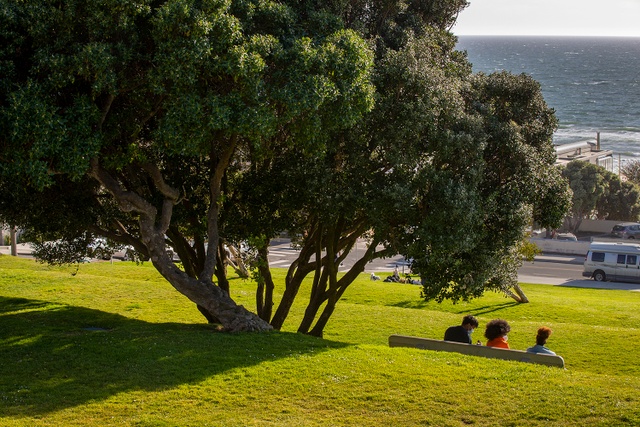
The park known today as Bruce’s Beach slopes down to the shore in Manhattan Beach.
Allen J. Schaben/L.A. Times via Getty Images
Los Angeles County officials revealed on Wednesday how they will transfer the Manhattan Beach property known as Bruce's Beach to the descendants of its original Black owners, who were driven from town in the 1920s by disgruntled white neighbors. After the transfer of the oceanfront park, estimated to be worth $20 million, the county will rent it from the family for $413,000 a year. L.A. Times | Daily Breeze
In case you missed it
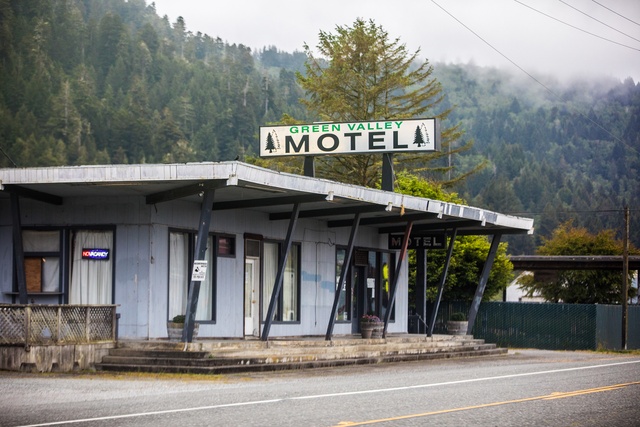
A motel in Orick, which has fallen on hard times.
Five items that got big views over the past week:
| • | The town of Orick serves as a gateway to Redwood National and State Parks yet looks like the setting for a zombie movie. "Driving through the town on Highway 101 to get to the park, you pass boarded-up motels, ramshackle houses, rusted-out cars, and properties that look like junkyards," Greg Rosalsky wrote. NPR |
| • | Five friends from Santa Barbara have posed for the same photo at a California lake every five years since 1982. Last week, after 40 years of graduations, jobs, marriages, and children, they gathered for their ninth photo, still friends and still cranking up the Rush and Pink Floyd. CNN |
| • | On Santa Rosa Island, archaeologists have found entire Chumash villages, numerous graves, and the bones of pygmy mammoths. In a travel story, Alex Krowiak recommended you visit, not only for the scenery but to connect to the continent's deep history and culture. National Geographic |
| • | An obscure religious sect based in the Sierra foothills has gained a foothold inside a business unit at Google. Founded in 1970, the Fellowship of Friends believes that higher consciousness is attainable through fine arts and culture. N.Y. Times |
| • | There's a surf break in Newport Beach called the Wedge where steep waves break perilously close to the shore, tossing even pros like rag dolls. A surfing filmmaker cut together a reel of the gnarliest 50 wipeouts. YouTube (14 mins) |

Thanks for reading!
The California Sun is written by Mike McPhate, a former California correspondent for the New York Times.
The Sun is built by Marquee on Proof.
Please tell us how we can make the newsletter better. Email mike@californiasun.co.